
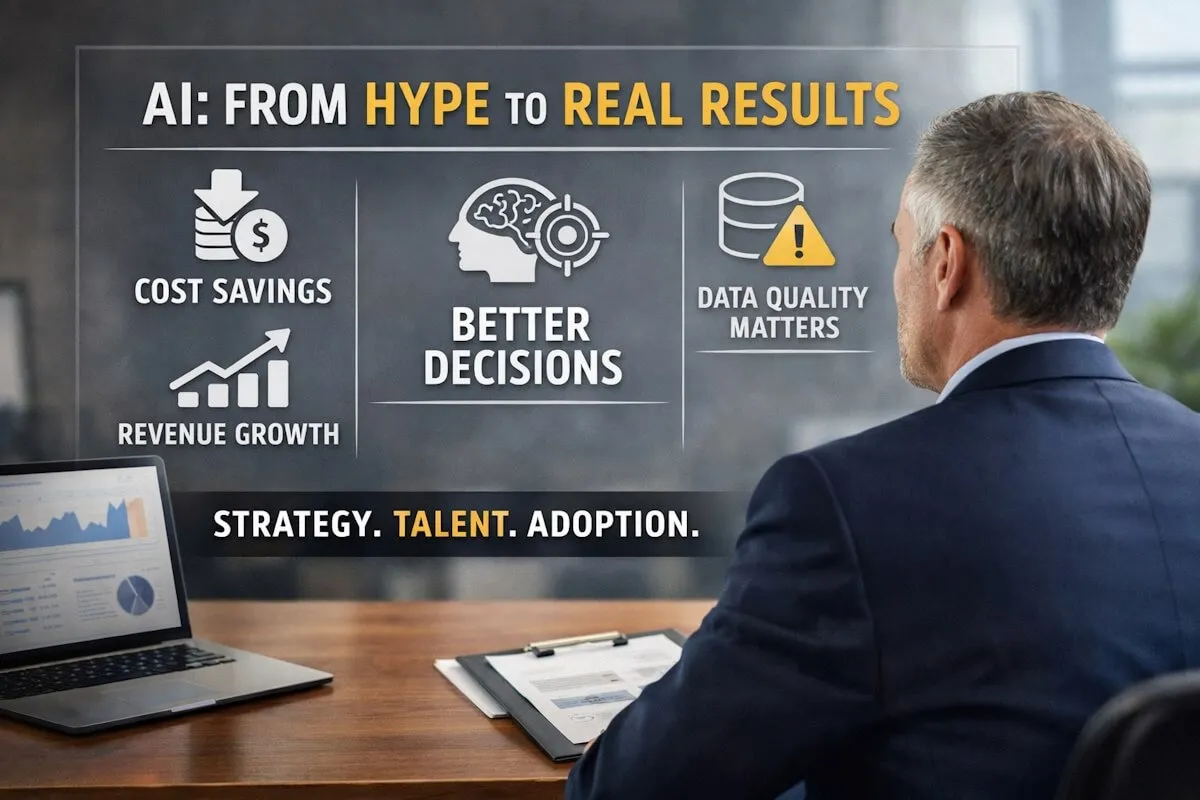

There’s a lot of noise around AI right now. Every other vendor promises faster growth, lower costs, and smarter decisions. Sounds great on paper. But as a CEO, you’re not here for buzzwords. You’re here for results.
So let’s get real for a minute.
What does ROI from AI actually look like? Where does it show up in your business? And why do some companies see gains while others just burn budget?
Let’s break it down in plain terms.
AI ROI Isn’t Instant. And That’s the First Reality Check
You don’t plug in AI and suddenly double your revenue. That’s not how it works.
Most returns come in layers. Small improvements stack up. Over time, they start to matter.
You might see:
- Faster customer support responses
- Reduced manual work in operations
- Better demand forecasting
- Smarter marketing spend decisions
None of these sound flashy alone. Put them together, though, and they shift your margins.
The catch? You need patience. And clarity.
Are you solving a real problem or just experimenting because everyone else is?
That question alone can save you a lot of money.
Cost Reduction Is Just One Piece of the Puzzle
A lot of CEOs focus only on cost savings. It’s easy to measure, sure. But it’s not the full picture.
Yes, AI can reduce workload. Fewer repetitive tasks. Less human error. Lower support overhead.
But there’s more.
Think about:
- Revenue growth from better personalization
- Higher conversion rates
- Improved customer retention
- Faster product iterations
These are harder to track. But often more valuable.
If you’re only looking at cost cuts, you’re leaving money on the table.
The Real ROI Comes From Decision-Making
Here’s where things get interesting.
AI isn’t just about automation. It’s about helping you make better decisions, faster.
Imagine:
- Knowing which leads are worth chasing
- Spotting churn risks before they happen
- Adjusting pricing based on real-time demand
- Identifying operational bottlenecks early
That’s where ROI compounds.
It’s not about replacing your team. It’s about giving them sharper tools.
And when your team makes better calls consistently, the business moves differently.
Bad Data Will Kill Your ROI
Let’s be blunt.
If your data is messy, outdated, or incomplete, AI won’t fix it. It will amplify the problem.
Many companies rush into AI without cleaning up their data first. Then they wonder why results feel off.
You need:
- Structured and reliable data
- Clear data ownership
- Consistent data flow across systems
Without this, even the best AI setup won’t deliver.
This is often where experienced partners offering AI Development Services can make a difference. They help you build from a solid base instead of stacking tech on chaos.
Talent Still Matters. A Lot.
There’s a misconception that AI reduces the need for skilled people.
It doesn’t.
You still need:
- People who understand your business
- People who can interpret outputs
- People who can adjust strategy based on insights
AI gives signals. Humans decide what to do with them.
That’s why many companies choose to Hire AI Developers who can align the technology with business goals, not just build models for the sake of it.
Without the right talent, tools sit idle. Or worse, they create confusion.
Not Every Use Case Is Worth It
This might sound obvious, but it gets ignored all the time.
Just because you can apply AI doesn’t mean you should.
Some processes are already efficient. Some don’t have enough data. Some won’t generate meaningful returns.
Start with high-impact areas:
- Customer support automation
- Sales forecasting
- Fraud detection
- Inventory management
Test small. Measure results. Expand only when it makes sense.
Going all-in too early is one of the fastest ways to waste budget.
Time to Value Is Often Underestimated
Another thing CEOs overlook?
How long it takes to see results.
There’s:
- Setup time
- Data preparation
- Model training
- Testing and adjustments
- Team adoption
Each step takes time.
If you expect instant returns, you’ll likely get frustrated.
Instead, think in phases:
- Short-term wins
- Mid-term improvements
- Long-term gains
That mindset keeps expectations realistic and teams focused.
Adoption Is Where Most Efforts Fail
You can build the best AI system in the world. If your team doesn’t use it, it’s useless.
Adoption is often the missing piece.
Ask yourself:
- Does your team trust the output?
- Do they understand how to use it?
- Is it integrated into their daily workflow?
If the answer is no, ROI won’t show up.
You need training. Clear processes. And sometimes a cultural shift.
People don’t resist technology. They resist confusion.
ROI Needs Clear Measurement From Day One
If you don’t define success early, you won’t know if AI is working.
Set clear metrics:
- Cost per support ticket
- Lead conversion rate
- Customer retention rate
- Time saved per task
Track them before and after implementation.
This sounds simple, but many skip it.
Then months later, they’re unsure if the investment paid off.
Don’t fall into that trap.
The Role of the Right Tech Partner
You don’t have to figure everything out alone.
The right partner doesn’t just build. They guide.
They help you:
- Identify the right use cases
- Avoid unnecessary complexity
- Set realistic expectations
- Build scalable systems
That’s where working with a team offering AI Development Services becomes practical, not just technical.
And if you need ongoing support or custom solutions, it makes sense to hire AI Developers who can stay aligned with your evolving business needs.
So, What Should You Really Focus On?
Let’s simplify this.
If you’re a CEO thinking about AI, focus on:
- Solving real business problems
- Starting small and scaling smart
- Ensuring data quality
- Investing in the right talent
- Driving team adoption
- Measuring what matters
Skip the hype. Stick to outcomes.
Because at the end of the day, AI is just a tool.
What matters is how you use it.
Final Thought: ROI Is Built, Not Bought
There’s no shortcut here.
AI ROI doesn’t come from buying a tool. It comes from making the right decisions, step by step.
Some wins will be quick. Others will take time.
But if you stay focused on value, not trends, you’ll see results that actually matter to your business.
And that’s what you’re really after, right?